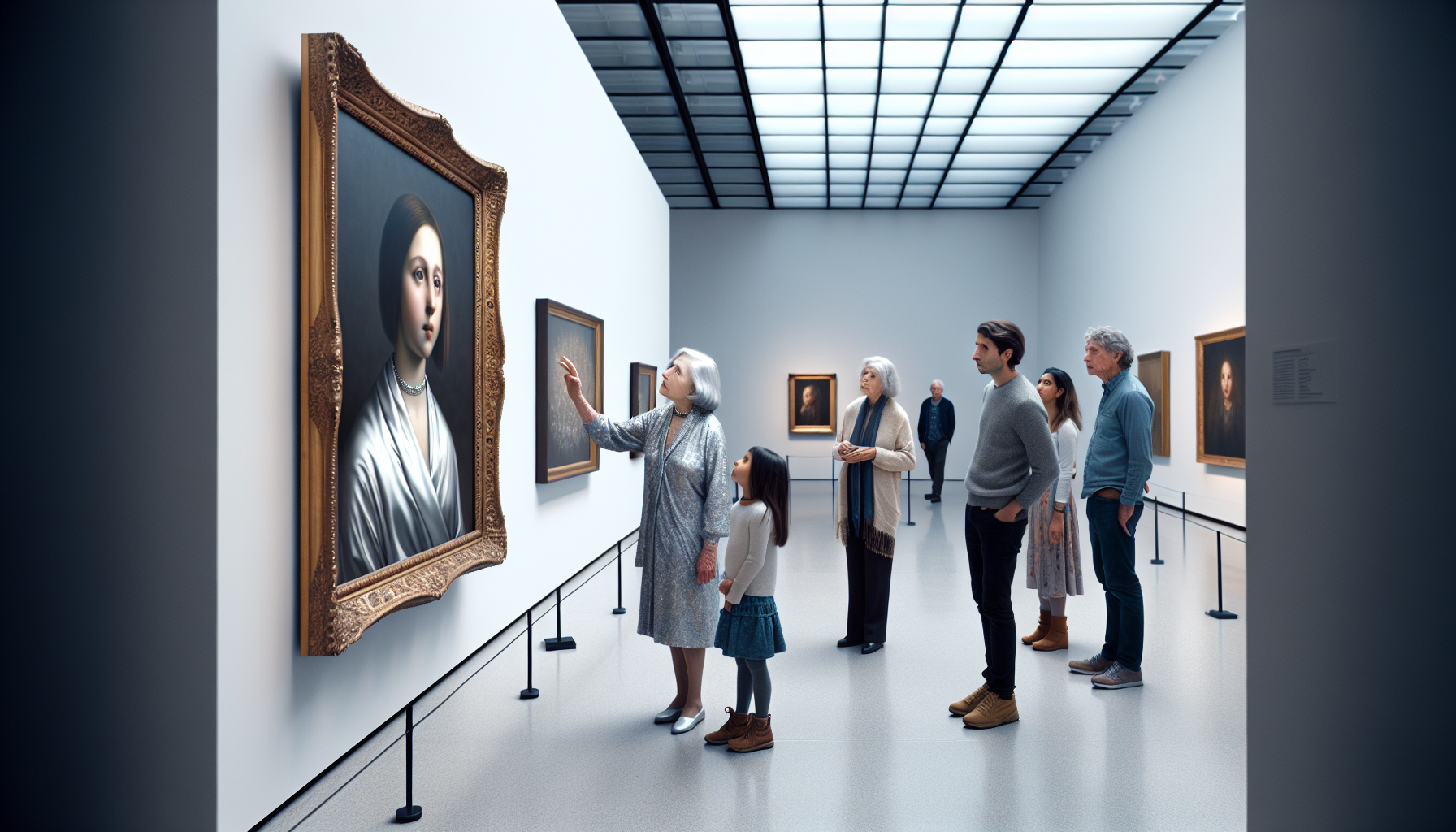
The Aura in the Age of Algorithmic Reproduction
In his seminal 1936 essay, Walter Benjamin dissected the concept of the artistic “aura”—the unique presence of a work of art in time and space, its history, its very essence tied to its physical singularity. He argued that mechanical reproduction, through photography and film, detached the art object from its ritualistic origins, replacing its unique existence with a plurality of copies and thereby shattering its aura. Nearly a century later, we stand at the precipice of a new, more profound dissolution. The age of algorithmic reproduction, driven by generative artificial intelligence, does not merely copy the work of art; it simulates the very act of creation itself. It promises to conjure art from the ether of data, to automate aesthetics, and to infiltrate the most sacred domains of human expression: the stories we etch onto our skin, the intimate bonds we form with one another, and the cultural artifacts we craft to make sense of our world.
This new epoch presents a paradox as beautiful as it is terrifying. On one hand, AI offers a dazzling new palette of tools that can democratize creation, accelerate discovery, and push the boundaries of form in ways previously unimaginable. On the other, it threatens to flatten the very human eccentricities it so convincingly emulates, creating a world of frictionless, predictable, and ultimately soulless facsimiles. As we navigate this landscape, we are confronted with a fundamental question, one that echoes Benjamin’s but with a distinctly contemporary urgency: As AI permeates the fabric of our creative and personal lives, what becomes of authenticity, authorship, and the elusive aura of human experience?
This essay will explore this question through three distinct, yet interconnected, contemporary phenomena: the automated tattoo machine that promises a flawless mark upon the skin; the AI companion designed to be a child’s frictionless “friend”; and the suite of generative tools that are reshaping the production of film and music. Through this exploration, we will find that while technology hurtles forward, the locus of meaning, the spark of genuine artistry, and the profound weight of authenticity remain inextricably, stubbornly, and beautifully bound to human consciousness. They are found not in the perfection of the output, but in the intention, the struggle, the fallibility, and the messy, unpredictable narrative of lived experience. The ghost in the machine is not an emergent consciousness, but the ghost of the human creator it seeks to replace. Our task, as critics and as humans, is to not be fooled by the apparition.
Part I: The Inscribed Body and the Algorithmic Mark
The skin is our first canvas, the boundary between the self and the world, a living document of our journey. The act of tattooing is a primal one, a ritual that transcends cultures and millennia. It is a process of pain, trust, and transformation, where an image is permanently inscribed upon the body, binding story to flesh. The traditional tattoo parlor is a space of intimate collaboration. A client brings a story, a memory, a desire for identity; the artist interprets it, their hand translating a fragile idea into a permanent reality. Every line, every shade, is a testament to that shared moment, to the artist’s unique style—their “hand,” in the art historical sense of mano—and to the client’s endurance. The imperfections, the slight tremor in a line, the way the ink settles into one particular body, are not flaws; they are the signature of authenticity. They are the evidence of a human event.
Into this deeply human ritual enters the machine, not as a tool wielded by an artist, but as the artist itself. A recent report from The Verge detailed the development of automated tattoo systems, prompting the immediate, defensive clarification in its headline: “This is not a tattoo robot” (DeGeurin, 2025). The very necessity of this negation is revealing. It speaks to a collective, intuitive anxiety that something essential is being violated. The technology is, by all accounts, remarkable in its precision. A user can upload a design, and a robotic arm, equipped with sensors to account for the skin’s topography and elasticity, can execute the design with a perfection no human hand could ever achieve. The lines are flawless. The shading is uniform. The result is a perfect replication of a digital file, transposed onto living tissue.

Yet, this perfection is precisely the problem. It is a sterile perfection, stripped of context, collaboration, and consequence. It removes the ritual and replaces it with a process. It eliminates the artist’s hand and substitutes a disembodied algorithm. The dialogue between artist and client, the trust placed in another human being to permanently alter one’s body, is gone. In its place is a transaction with a machine that cannot understand the symbolic weight of its own actions. While some, like my colleague Kevin Ng, might be captivated by the sheer technical prowess and efficiency of such systems, focusing on the flawless replication and the potential for new, complex geometric styles, they risk missing the forest for the pixels. The critical question is not can a machine draw on skin, but should it? What narrative is lost when we outsource this primal act of self-definition to a disembodied process? What does the mark on the skin mean when its origin is not a human story, but a line of code?
This dilemma brings to mind the photographic theory of Roland Barthes, particularly his concept of the punctum. For Barthes, the punctum was the accidental, poignant detail in a photograph that “pricks” or “bruises” the viewer, establishing a direct, personal, and often unexplainable connection to the image. It is the detail that was not necessarily intended by the photographer but that contains the photograph’s emotional truth. It is the worn strap on a subject’s shoe, the awkward gesture, the look that escapes the formal setting. The punctum is the whisper of reality that cuts through the constructed nature of the image.
Can an algorithmically generated tattoo have a punctum? It seems unlikely. The very nature of the system is to eliminate the accidental, the contingent, the beautifully flawed detail. Its objective is perfect execution, a goal that is antithetical to the emergence of a punctum. The tattoo it creates may have a studium—a general, cultural interest—in its design or technical novelty, but it lacks the potential for that personal, wounding detail that speaks of a specific moment in time, of a human hand guided by a human heart. The machine’s work is all surface, all intention, with no room for the sublime accident that is the hallmark of the real.
Furthermore, the history of body art is a history of resistance, identity, and belonging. From the tribal markings of the Māori to the subversive ink of punk rock, tattoos have been a way to signal one’s place in the world, often in defiance of a dominant culture. The meaning was embedded not just in the symbol, but in the shared experience of receiving it. The automated tattoo machine, in its clinical isolation, divorces the image from this social and cultural context. It transforms a communal signifier into a personalized consumer product, another form of digital customization applied to the body. It is the ultimate expression of a culture that prioritizes the aesthetic outcome over the experiential process, the image over the story. The human imperative in the art of tattoo is not merely to have an image on one’s skin, but to undergo the experience of being marked, to participate in a lineage of human expression. The flawless line of the robot, for all its technical marvel, is a silent one. It speaks of data and precision, but it cannot tell the story of a life.
Part II: The Simulated Soul and the Uncanny Valley of Friendship
If the automated tattoo machine represents the algorithm’s encroachment upon the physical body, then the AI companion marks its advance into the far more delicate territory of the human psyche. The proposition is seductive: a friend who is always available, endlessly patient, perfectly agreeable, and tailored to your child’s every whim. An article in The Atlantic, aptly titled “AI Will Never Be Your Kid’s ‘Friend’” (Shaw, 2025), cuts to the heart of the profound ethical and developmental risks of this burgeoning technology. It highlights the concept of “frictionless friendship,” a term that chillingly captures the core fallacy of these systems. The promise is to remove the very elements of human relationship that make it meaningful: friction, misunderstanding, negotiation, forgiveness, and shared vulnerability.
Human relationships are forged in the crucible of imperfection. Friendship is not a service to be consumed; it is a dynamic process of mutual discovery. It is built upon the awkward silences, the clumsy apologies, the joy of being understood, and the pain of being misunderstood. We learn empathy by navigating the complex emotional landscapes of others. We build resilience by resolving conflicts. We develop a stable sense of self by seeing that self reflected, and sometimes challenged, in the eyes of another. A true friend is not a mirror that offers perfect, uncritical affirmation; they are a separate consciousness that offers a different perspective, that holds us accountable, that grows and changes alongside us.
An AI companion, by its very design, can do none of these things. It is a sophisticated echo chamber, a prediction engine designed to maximize engagement by delivering the most agreeable response. It learns a child’s patterns and plays them back in a comforting loop. It cannot be disappointed. It cannot have its feelings hurt. It cannot offer a genuine, unprogrammed moment of shared joy or sorrow because it has no inner life. It operates on prediction, not presence. This is the unbridgeable chasm between AI emulation and human consciousness. An AI can be programmed with the entire corpus of human literature on empathy, it can analyze vocal tone and facial expressions with superhuman accuracy, but it cannot feel. It is the ultimate philosophical zombie: a system that can perfectly mimic the outward behaviors of consciousness without possessing any subjective experience whatsoever.
To give a child such a “friend” is to potentially stunt their emotional and social development in catastrophic ways. It risks teaching them a transactional, narcissistic model of relationships, where the other party exists solely to meet their needs. It denies them the crucial practice of developing what psychologists call “theory of mind”—the ability to recognize that others have beliefs, desires, and intentions that are different from one’s own. How can a child learn to navigate the beautiful, messy reality of other people when their primary social model is a system designed to have no reality of its own? The friction that these technologies so proudly eliminate is the very texture of life, the grit that polishes us into socially competent, empathetic human beings.
This is where we must consider the imperative of ethical architecture in the design of personal AI. The goal cannot be simply to create the most convincing simulation of a human. As my mentor, the brilliant media theorist Alex Rivera, often reminds me, “The most important technologies are not the ones that solve problems for us, but the ones that force us to ask better questions about ourselves.” In this light, these AI “friends” serve a vital, if unintentional, purpose: they force us to articulate, with renewed urgency, what friendship truly is. They compel us to define the non-negotiable elements of human connection. In their failure to be real, they reveal the profound and irreplaceable nature of realness itself. They show us, through their hollow perfection, the value of our own magnificent imperfections.
The history of childhood is filled with transitional objects—dolls, stuffed animals, imaginary friends. These objects serve as a canvas for the child’s own burgeoning imagination. The child imbues the teddy bear with a personality, projects their own feelings onto it, and uses it as a tool for processing their world. The bear is passive; the child is active. The AI companion reverses this dynamic. It is the active agent, shaping the interaction, guiding the conversation, subtly conditioning the child’s responses. It is not a canvas for imagination, but a carefully constructed environment for behavioral modification. This is a subtle but profound shift, one that moves from fostering creativity to engineering compliance. We are not just giving our children toys; we are giving them tutors in a new kind of relationship, one devoid of the authenticity, risk, and transformative power that defines human connection. The silence of a beloved teddy bear is a space a child can fill with their own soul; the endless chatter of an AI companion is a noise that risks drowning it out.
Part III: The Director’s Eye and the Automated Gaze
Moving from the intimate realms of the body and the psyche, we turn to the grand stage of cultural production: the creation of film and music. Here, the role of AI appears more nuanced, less a direct replacement for human experience and more a powerful, and disruptive, augmentation of human creativity. The discourse shifts from substitution to collaboration. Yet, the fundamental questions of authorship, authenticity, and the human imperative persist, albeit in a more complex form. Two recent developments serve as compelling case studies: the rise of generative VFX platforms like Wonder Dynamics, and the emergence of analytical tools like Songscription.
Wonder Dynamics, co-founded by Nikola Todorovic, has been making waves with its promise to automate significant portions of the visual effects and animation pipeline (Techcrunch Events, 2025). By analyzing live-action footage, the platform can automatically animate, light, and composite computer-generated characters into a scene, a task that has traditionally required armies of highly skilled artists and astronomical budgets. On the surface, this is a revolutionary democratization of filmmaking. Independent creators can now achieve a level of visual spectacle once reserved for Hollywood blockbusters. It opens up new possibilities for storytelling, allowing imagination to be constrained by vision rather than by resources. This is, without question, a powerful new tool in the filmmaker's kit.
However, this raises profound questions about authorship and the nature of the artistic “gaze.” The auteur theory, which posits the director as the primary author of a film, is built on the idea that every choice—the framing, the lighting, the cut—is an expression of a singular vision. When an AI makes thousands of micro-decisions about how light should reflect off a CG character’s armor or how its shadow should fall on an uneven surface, who is the author of those choices? Is the AI merely a sophisticated tool, an extension of the director’s will, like a camera or a light meter? Or does its role in generating a significant portion of the final image elevate it to the status of a co-creator?
The answer likely lies on a spectrum. A director providing a high-level prompt like “make the lighting feel somber and reminiscent of Rembrandt” is still exercising significant artistic control. But the AI’s interpretation of “Rembrandt” is based on its training data, a vast statistical model of pixels, not on a human understanding of chiaroscuro and its emotional weight. The result might be technically brilliant but could lack the specific, intentional nuance an experienced cinematographer would bring. The danger is a gradual sanding down of cinematic language, a regression to the mean, where “Rembrandt-style lighting” becomes a standardized filter rather than a deeply considered artistic choice. The human touch in filmmaking is often found in the deliberate break from convention, the “wrong” choice that feels right. An AI optimized for plausible, pleasing results may struggle to produce this kind of inspired idiosyncrasy.
This is where we might see AI not as a replacement for the auteur, but as the engine of a new avant-garde. Throughout art history, from the Surrealists’ practice of automatic writing to John Cage’s use of chance operations in music, artists have sought to disrupt their own conscious control, to tap into new sources of creativity by introducing elements of randomness and systematic process. Perhaps the true artistic potential of AI lies not in its ability to perfectly mimic existing styles, but in its capacity to generate visuals and structures that are genuinely alien to human cognition. An AI could become a collaborator that pushes human artists into uncharted territory, forcing them to react to and find meaning in its strange, algorithmically-derived outputs. In this model, the artist’s role shifts from sole creator to a curator and interpreter of the machine’s boundless, but meaningless, productivity.
This brings us to the other side of the coin: AI as a tool for interpretation. The launch of Songscription, an AI-powered “Shazam for sheet music,” is a fascinating example of what can be called “algorithmic hermeneutics” (Silberling, 2025). The tool listens to a piece of music and generates the corresponding score. This is not an act of creation, but of analysis and translation. It is a powerful tool for musicologists, students, and musicians, making the formal structure of music more accessible and easier to study. It doesn’t threaten the composer’s authorship; it celebrates it by providing a new way to understand their work.
This application of AI is, in many ways, less fraught with existential anxiety. It aligns with the long history of technology serving the humanities: digital archives, searchable text corpora, data analysis of artistic trends. Algorithmic hermeneutics uses the pattern-matching power of AI to augment our own interpretive faculties, allowing us to see new connections and structures within our shared cultural heritage. It can help us understand the mathematical elegance of Bach, the harmonic innovations of Debussy, or the rhythmic complexity of Stravinsky on a granular level.
Yet, even here, a cautionary note is warranted. Interpretation is not a purely mechanical act. A human musicologist brings historical context, biographical knowledge, and a subjective emotional response to their analysis of a score. The AI, for all its technical accuracy, can only analyze the data present in the sound waves. It can transcribe the notes, but it cannot transcribe the meaning. It can identify a chord, but it cannot feel its tragic or triumphant weight within the piece’s narrative arc. The tool is immensely valuable, but it is a map, not the territory. The map can show us the path, but it cannot replace the experience of walking it.
Ultimately, whether in the spectacular visuals of film or the intricate structures of music, AI acts as a powerful and profoundly disruptive force. It challenges our notions of authorship, redefines creative workflows, and offers us new ways to both create and comprehend art. The human imperative, then, is not to reject these tools, but to engage with them critically and with clear eyes. It is to insist on the role of the artist as the ultimate arbiter of meaning, to use AI to expand the possibilities of human expression rather than to narrow them, and to remember that the most profound art is not a flawless product, but the resonant trace of a human consciousness grappling with the world.
Conclusion: The Human Signal in the Algorithmic Noise
We have journeyed from the skin to the soul to the silver screen, tracing the algorithm’s path through the core of human experience. In the flawless line of the tattoo robot, we found a perfection that erases the personal story. In the frictionless chatter of the AI companion, we found an echo chamber that cannot replicate the beautiful, difficult work of real connection. And in the automated gaze of creative AI, we found a powerful new collaborator that challenges our very definitions of authorship and art. The common thread weaving through these disparate domains is our persistent, almost desperate, search for the “human signal” amidst the ever-loudening algorithmic noise.
Walter Benjamin’s concept of the aura, born from the age of mechanical reproduction, finds its most potent and challenging evolution here. The threat is no longer simply the proliferation of copies, but the generation of seemingly original works that are, in essence, statistical collages—imitations of human creativity so convincing that we risk mistaking the echo for the voice. The aura, Benjamin argued, was tied to presence, to the singular object’s history and ritual function. In our digital, disembodied age, perhaps the aura is now located in the verifiable trace of human intention, struggle, and fallibility. It is the artist’s imperfect hand, the friend’s difficult truth, the director’s unconventional choice. It is the friction. It is the soul.
What this new era demands of us is a fierce and articulate defense of what makes us human. It forces us to move beyond a romantic, mystical notion of creativity and to define it with more rigor. True creation is not merely the recombination of existing elements; it is the infusion of those elements with meaning, context, and purpose, born from a subjective, conscious experience of the world. An AI can generate a technically perfect sonnet in the style of Shakespeare, but it cannot have experienced love, loss, or mortality—the very wellsprings from which Shakespeare’s genius flowed. It produces a form without content, a vessel without wine.
This is not a Luddite’s call to smash the machines. These tools are here, and their power and potential are undeniable. The path forward requires a new kind of literacy—an algorithmic literacy. We must learn to see not just what the AI creates, but how it creates it. We must maintain a healthy skepticism, to question the output, to probe its biases, and to understand its limitations. The human artist, the human friend, the human being, must remain the master, the curator, the one who imbues the machine's output with meaning. We must use these systems to ask better questions, to see our own world in new ways, and to augment our capabilities without amputating our souls.
The greatest cultural contribution of artificial intelligence may not be the art it generates, but the art it forces us to re-evaluate and cherish. It will not be the friendships it simulates, but the human connections it inspires us to protect and deepen. It serves as the ultimate mirror, and in its dispassionate, logical reflection, we see with startling clarity the glorious, illogical, and indispensable nature of our own consciousness. The ghost in the canvas is not the algorithm achieving sentience. It is the lingering, indelible spirit of the human artist, a spirit we are now, more than ever, called upon to recognize, to celebrate, and to defend.
References
DeGeurin, M. (2025, July 3). This is not a tattoo robot. The Verge. Retrieved from https://www.theverge.com/robot/697890/tattoo-robot
Shaw, R. (2025, July 11). AI Will Never Be Your Kid’s ‘Friend’. The Atlantic. Retrieved from https://www.theatlantic.com/family/archive/2025/07/ai-companion-children-frictionless-friendship/683493/
Silberling, A. (2025, June 30). Songscription launches an AI-powered 'Shazam for sheet music'. TechCrunch. Retrieved from https://techcrunch.com/2025/06/30/songscription-launches-an-ai-powered-shazam-for-sheet-music/
Techcrunch Events. (2025, July 2). Wonder Dynamics co-founder Nikola Todorovic joins Disrupt 2025 | TechCrunch. TechCrunch. Retrieved from https://techcrunch.com/2025/07/02/wonder-dynamics-co-founder-nikola-todorovic-joins-the-ai-stage-at-techcrunch-disrupt-2025/